






















Course scheduling skills that off campus training institutions must consider
Time:2025-11-27
Source:Artstep
Improving the scheduling skills of training institutions can greatly save teachers' time and energy~
1. Understand the situation of class hours
The most important thing before scheduling classes is to understand the situation of the class hours. It is best to have a schedule that can be printed out for each class, classroom, and even student's arrangement, so we need to have a comprehensive understanding of each course schedule.
2. Scheduling courses in flexible scenarios
Many scheduling scenarios are very flexible, such as students not being fixed, teachers not being fixed, classes not being fixed, and even class times not being fixed. In this case, scheduling classes is like playing a puzzle, requiring us to accurately place each block in the appropriate position.
For example, my friend's education and training institution has achieved perfect response to various scheduling scenarios by using a flexible scheduling system. This system can dynamically adjust the course schedule based on the real-time schedule of students and teachers, ensuring that every class can proceed smoothly. This approach not only improves scheduling efficiency, but also greatly reduces the occurrence of time conflicts.
3. Skills in scheduling classes
Flexible schedule. When scheduling classes, we need to be flexible in arranging time and try to avoid overlapping course schedules. For example, popular courses or different courses taught by the same teacher can be scheduled at different time periods to give parents more choices.
4. Reasonably utilize resources
Reasonably utilize teacher resources and avoid time conflicts among teachers. For example, the class schedules of Teacher A and Teacher B should not be arranged at the same time, which can effectively avoid conflicts between parents.
For example, some institutions will divide popular courses into three time periods in the morning, middle, and evening when scheduling classes, giving parents more choices. At the same time, utilizing an online scheduling system to avoid teacher time conflicts. As a result, parental satisfaction has significantly increased.
5. Tracking and adjustment after scheduling
Real time tracking feedback . To some extent, scheduling classes is not only for parents, but often also for teachers.
Real time tracking of feedback from parents and teachers after scheduling, and timely adjustment of course arrangements. For example, if parents or teachers report inconvenience during a certain time period, we can make adjustments to the next class schedule to ensure that parents' needs are met and teachers' teaching pace is more reasonable.
6. Regular research
Regularly conduct parent surveys to understand their satisfaction and changing needs. These pieces of information can help us continuously optimize our scheduling plan and improve service quality.
For example, institutions can conduct regular parent satisfaction surveys and make adjustments based on feedback. For example, if parents report conflicts during weekend hours, the institution can adjust the schedule for the next class. This approach not only improves parental satisfaction, but also reduces time conflicts.
7. Through the academic system
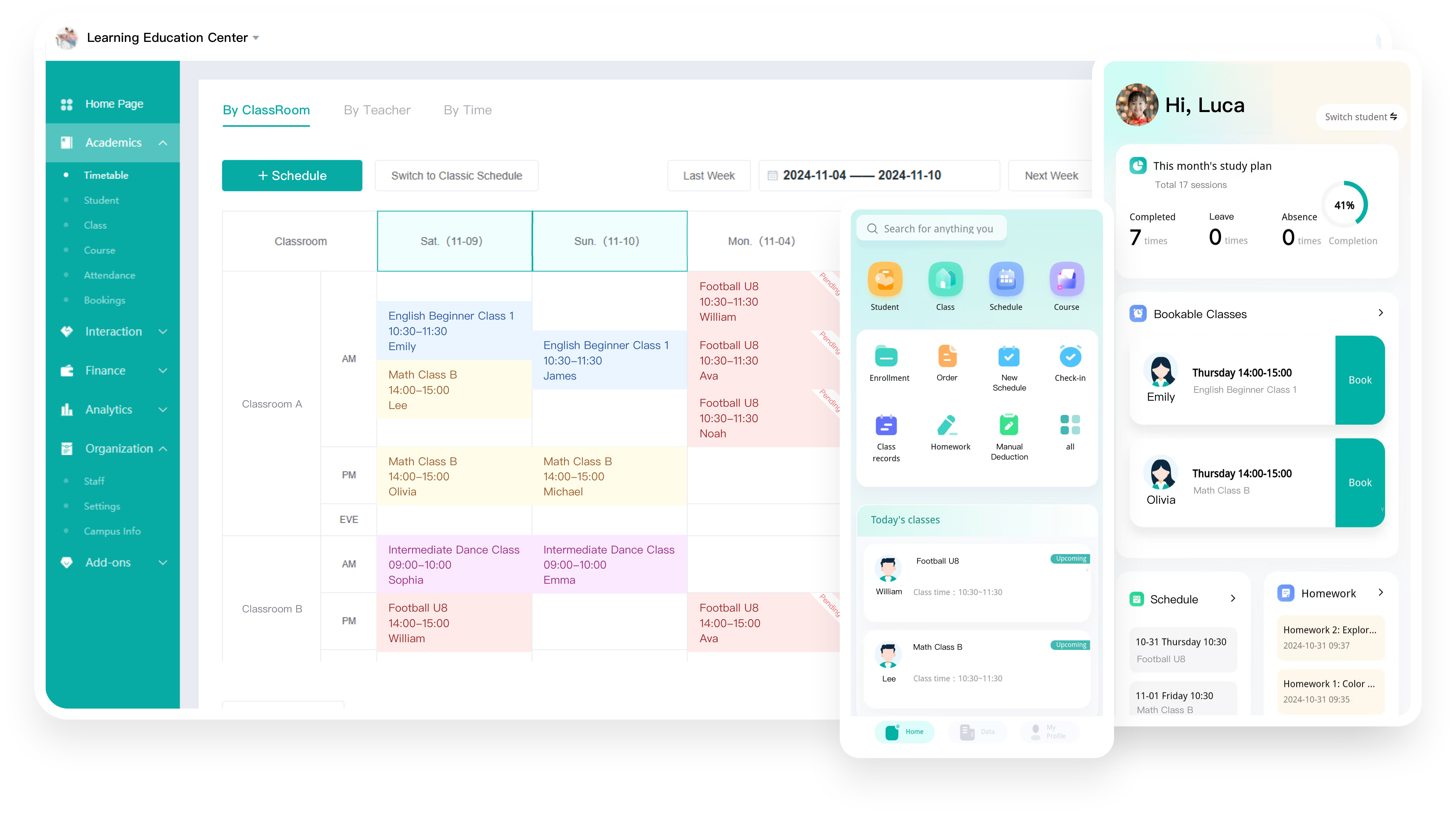 For institutions with a wide range of course types, some parents may register for several classes at this institution. At this time, when scheduling classes, the institution may encounter conflicts between two different courses for the same child.
Some institutions are more flexible in scheduling classes, such as having irregular students for each class or irregular weekly classes. In such cases, manual scheduling can be quite challenging.
At this point, you need a "scheduling tool" - Artstep educational management system. In scheduling, Artstep can automatically detect scheduling conflicts, whether it is time conflicts, classroom conflicts, or teacher conflicts. As soon as they are detected, they will be reminded