






















Smart Scheduling Made Easy: How to Prevent Clashes Between Private and Group Lessons
Time:2025-10-16
Source:Artstep
Running a training center sounds simple — until you start building your schedule.
That’s when chaos shows up.
Teachers juggling private lessons and group classes.
Parents requesting specific times.
Rooms double-booked.
And somehow, it’s always the piano room.
Over the years, I’ve worked with countless schools — from small art studios to large dance academies — and I can confidently say this: scheduling isn’t just about “when.” It’s about how people fit together.
The Real Challenge Behind Scheduling
Most school owners think conflicts happen because “the system failed” or “teachers didn’t communicate.”
But from my experience, the deeper reason is structural.
Private lessons demand flexibility. Group classes demand stability.
You can’t easily satisfy both without some sort of logic behind your calendar.
Here’s what I often see:
- Teachers get overloaded because they’re scheduled back-to-back across formats.
- Students in private lessons constantly shift their times, breaking the flow of the group schedule.
- Administrative teams spend weekends rewriting timetables by hand.
When that happens, the schedule stops being a plan — it becomes a negotiation.
Why Smart Scheduling Matters More Than Ever
If you’ve ever had to cancel a class because of a teacher conflict, you know how expensive that mistake can be.
Not just financially, but emotionally. Parents lose trust. Teachers lose motivation. Students lose rhythm.
Smart scheduling isn’t about technology alone — it’s about predicting pressure points before they appear.
In my early years consulting for schools, I used spreadsheets and color codes to track it all. It worked — until the school hit about 200 students. Then it turned into a mess. Every reschedule rippled through five other classes.
That’s when I realized:
Manual scheduling only works when your business is small enough to remember every detail. Once you grow, you need a system that remembers for you.
How I Learned to Balance Private vs. Group
Private lessons bring intimacy — you tailor progress to each student.
Group classes bring energy — students inspire each other.
But running both together is like blending oil and water unless you design clear boundaries.
I now advise schools to treat private and group classes as two ecosystems that share resources but follow different rhythms:
l Private lessons run best on rolling schedules with flexible booking.
l Group classes thrive on consistent, repeating slots. The key is not forcing them into the same pattern.
内Where Systems Like Artstep Come In
When I first tested Artstep, what struck me wasn’t the interface — it was the logic.
The platform doesn’t just store schedules; it understands them.
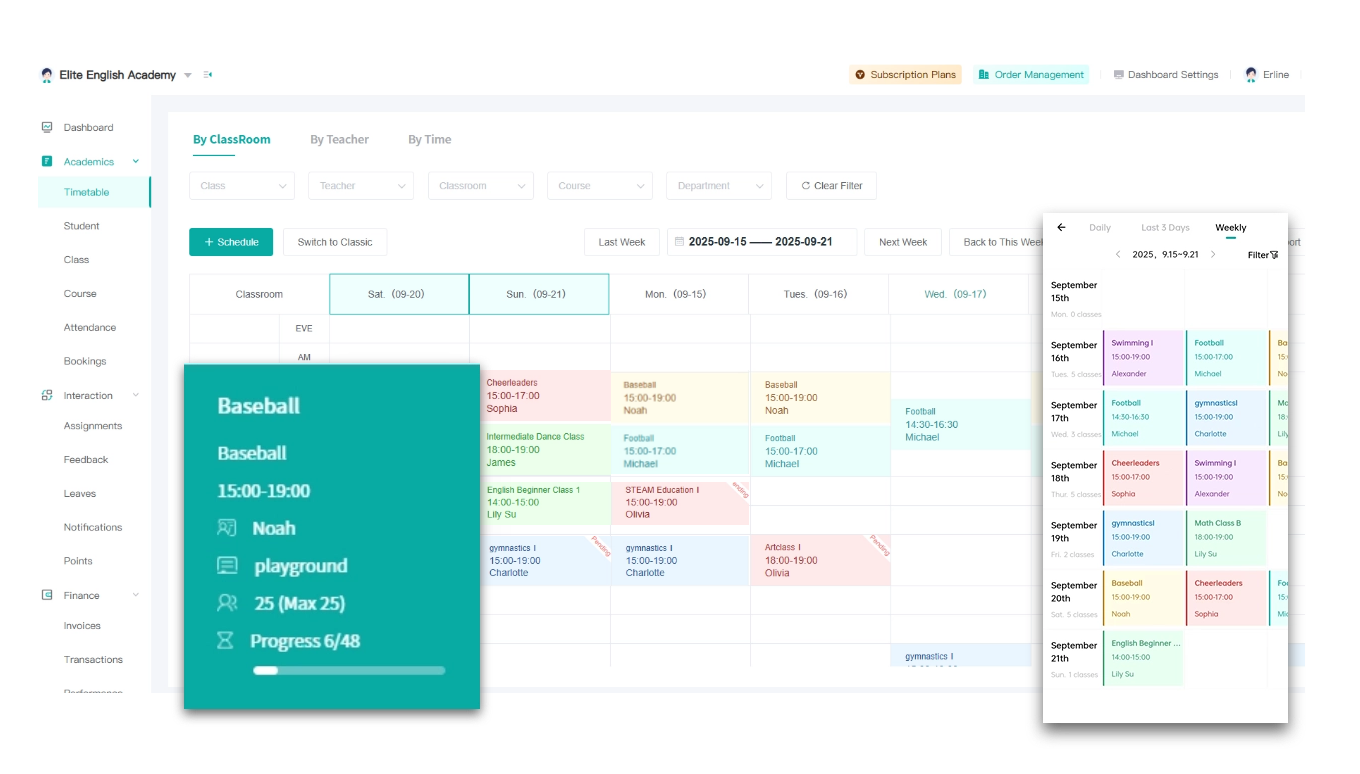
It automatically detects when a teacher or room is double-booked.
It lets you visualize both private and group lessons on one clear calendar.
And my favorite part: the one-on-one booking system.
Students or parents can directly request a private session, and Artstep syncs it with the teacher’s availability — no endless texting, no “sorry, that time’s taken.”
Every change is logged, every adjustment visible.
In my experience, this level of transparency changes everything.
Teachers feel supported.
Admins stop firefighting.
And parents start trusting the process again.
Why This Matters
If your schedule is constantly being rewritten, your energy isn’t going into teaching — it’s going into managing chaos.
Smart scheduling brings peace.
It’s what turns a growing training center into a sustainable one.
You don’t need a complicated system — you just need one that thinks with you.
Artstep happens to do that exceptionally well.
And after years of helping schools find balance between creativity and control, I can tell you — nothing feels better than a schedule that finally works for you, not against you.