






















How to operate an education and training institution well? Master these 12 questions:
Time:2026-01-27
Source:Artstep
1、 The reason why the education industry is called an industry depends on two aspects, one is teaching and the other is business:
Do not understand teaching, do not understand operators, be cautious when entering! Both options are the same, and there is a way to solve the other, unless you only invest! There is a jargon in this industry for reference only! No matter which industry you work in, it's never easy. Losing a lot of money is just squeezing out a smile! Although it is a sunrise industry, we should still be cautious!
2、 Three key words that make up educational institutions: teaching system, product system, and marketing packaging;
The teaching system is a set of solutions that involve both teachers and students, with a focus on presenting teaching effectiveness; The product system is the justification for this solution, which belongs to the sales and parent level. Why should we pay for it? How many class hours should I buy? Why do we need to renew after purchasing this course;
Marketing packaging is a set of language used in market promotion, starting from customer cognition and using understandable language to explain and express an organization's products, thereby inducing customers' desire to further understand.
The three are not the same content, but they share the same root and origin! The original prototype of an institution should start from these three aspects and then gradually supplement its personnel.
3、 The issue of opening classes in educational institutions requires the popularization of the concept of "class loss rate",
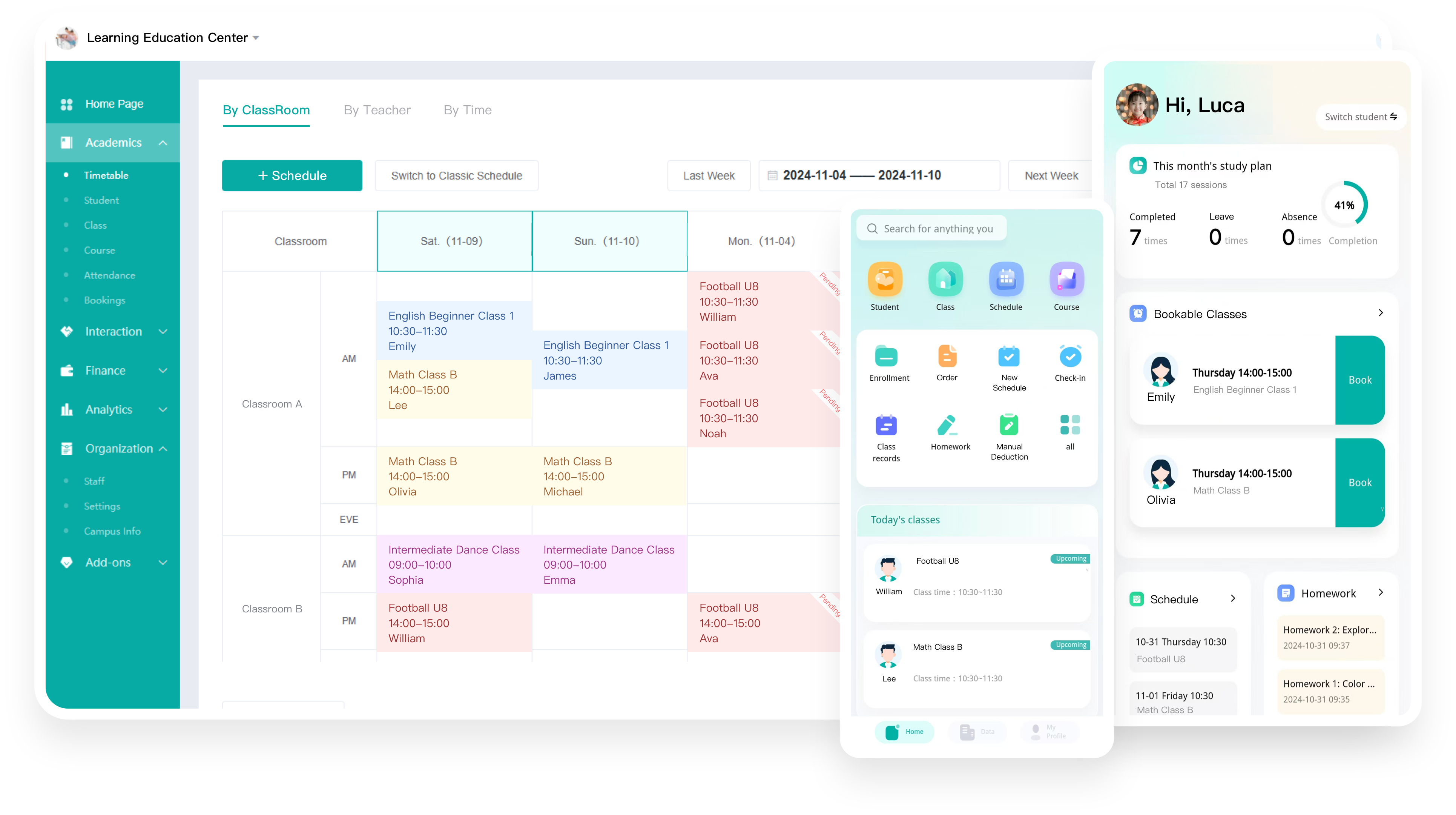
That is, classes start before the class is full. Of course, that's not a problem. The key is to find the critical point for starting a class, where a few people start the class without losing money, and a few people start the class with profit. We need to combine data such as overall cost, unit price of class hours, and class size to deduce this! Controlling the loss rate is an important means to ensure that institutions have profits, otherwise they will enter a situation where the boss does not make money and the employees make money.
4、 When institutions establish salary standards and assessment systems, they should pay attention to several issues:
1. Unresponsible base salary should be eliminated;
2. Avoid eating from the same pot;
3. Incomplete goal decomposition should be eliminated;
4. Only assessing the results without assessing the process should be eliminated; The purpose of the assessment system is to regulate, provide a minimum guarantee, and incentivize, not to deduct money, but to incentivize.
The recommended operating method is: basic salary (usually set as the local minimum wage standard)+performance (around 500-1000, used to control monthly goal achievement and specific performance, distributed proportionally)+commission (set minimum requirements, the more completed, the higher the points).
5、 Regarding the issue of institutional assessment system, here are a few points to share:
1. The salary setting follows the principle of basic salary + performance + commission, and performance is related to monthly assessment;
2. Implement assessment standards to specific target quantities, with fixed positions, personnel, and quantities;
3. The performance allocation ratio is generally 80% for assessing the completion of specific indicators, and 20% for assessing the process and daily performance;
4. The personnel ratio follows the principle of "more field work, less internal work" (i.e., priority is given to positions with output such as marketing and sales, while teaching and service positions are determined based on specific circumstances. For other positions without output, it is OK to be able to complete existing work.)
6、 How do educational institutions choose small gifts?
1. Practical and can be saved as the first principle; Pay more attention to user usage scenarios;
2. Attract attention and offer affordable prices;
3. Customizable logo for easy portability;
4. It is possible to print knowledge-based manuals related to institutional products (such as the global map of prestigious universities commonly used in the study abroad industry);
5. Visit local gift cities more often, you will reap rewards;
7、 Regarding the profitability of educational institutions
1. Flow, course consumption, carryover, cost, and profit are several key items;
2. It is further subdivided into course consumption rate, course unit price, and course consumption cycle. Generally, the longer the cycle, the greater the risk;
3. Carry over is not just about course carry over and current course consumption carry over, it needs to consider the overall cycle in order to plan the cash flow of the hand;
4. Many people may think that cash flow is important, but what is more important is the amount carried forward, which means ensuring the quality of teaching and the rate of course consumption;
5.The ideal state of an institution is: expenditure equals carry over, which equals balance; There is a risk of loss if the expenditure exceeds the carry over; Expenditure is less than carry over, there is profit margin.
6. Carefully comprehend it, the detailed formula is much more complex than this. Educational institutions operate linearly
7. The financial settlement of educational institutions can be roughly divided into: flow, carry over, cost, and profit; Tuition fees are recorded as revenue, and the cost is used for daily expenses. The profit is the actual income after deducting the cost from the transfer!
内容小标题文案
When asked how start-up institutions recruit students, they usually tell you to "do a good job of promoting within a radius of three kilometers". When there is no stock on hand, channel cooperation is zero; If the product has not been verified, the brand promotion is also zero. Start up institutions should avoid elevator and outdoor advertising, burn money, and not see any output in a short period of time. That is something that big brand institutions play with, with the ultimate goal of brand exposure. Start up institutions should have output for every penny.
9、 Regarding the location selection of institutions, share some opinions:
1. First determine the business and institutional positioning, and then consider the issue of site selection (early childhood education, children's education, K12? Community store, supermarket store? );
2. Then locate the target audience (parents' age, students' age);
3. Another factor is purchasing power (product pricing, household income);
4. Based on the data analyzed above, look at the location and focus on the supporting facilities within a radius of three kilometers (number of houses in the community, occupancy rate, surrounding facilities, large supermarkets, surrounding schools);
5. The final step is to determine the specific location.
10、 Educational institutions operate linearly, and regardless of their size, they should focus on four key points from resources to services:
1. Service oriented institutions rely on word-of-mouth resources to survive, but due to their many uncertain factors, it is difficult for them to expand;
2. Market oriented institutions will strive to expand their resource channels and continuously optimize on-site visits, contract signing, and services to ensure maximum output;
3.Regardless of the type of institution, optimizing services is essential. At the same time, the power of resources cannot be ignored. Without resources, no matter how high-quality the service is, it is difficult to survive!
4. The reputation resources are unstable and limited. At the same time, with external institutions constantly laying advertisements, to a certain extent, the reputation resources of institutions will become increasingly scarce, gradually falling into a difficult survival situation;
11、 An excellent course consultant should generally grasp the following three understandings:
1. Cognition of self growth: that is, a profound understanding of one's personality, strengths, career plans;
2. Understanding of the entire education industry: When facing customers, being able to tailor learning plans for them requires considering the entire education industry;
3. Understanding of the company and its products: the origin, philosophy, problems solved, and potential effects of institutional products
12、 Regarding how to start enrollment, the following ideas may be helpful to everyone:
1.Firstly, determine the product (including product design, marketing packaging);
2. Next, start market behavior (online, offline, with priority given to offline);
3. Then invite customers to visit (in conjunction with sales tools);
4. On site negotiation and consultation (in conjunction with product manuals);
5. Sign contracts, arrange classes, and provide teaching feedback.