






















How training institutions can provide good services
Time:2025-12-24
Source:Artstep
Either don't do it, or if you want to do it, make a unique feature
In educational and training institutions, high-quality teaching and services not only carry the main delivery work, but also play a key role in enhancing student experience, solving learning problems, establishing brand reputation, and ensuring the healthy operation of the institution. All of this requires institutional and research leaders to have more complete, systematic, and scientific cognitive requirements in the design of teaching and services.
The following are the core elements of "good service" for educational and training institutions summarized based on my more than 20 years of campus practical experience and competitive development experience. If you can lead the campus to achieve the following in terms of product competition, marketing competition, and management competition, as long as there is no quick exit with large capital in a short period of time, you will definitely be able to set your peers apart.
1. Professionalism in teaching and service
1.1 Scientific curriculum design: The curriculum system should not be complicated, the number of SKUs should be scientific, the class hours and cycles at each stage should be reasonable, and the logical design should meet the needs of delivery and operation;
1.2 Standardization of lesson plans: On the one hand, teachers should have professional qualifications and experience, and on the other hand, the teaching steps and processes of teachers should be managed consistently to avoid personal factors from different campuses and teachers affecting the delivery of teaching and services;
1.3 Standardization of teaching services, academic services, and student services: There are unified standards for evaluating, serving, testing, and learning reports for students, rather than individual arbitrary expression or AI generated jargon. They should have objective data-driven and linear process presentation, without piling up irrelevant adjectives to describe, allowing students and parents to visually see the process of data changes in learning;
2. Personalized services for learning
2.1 Ability to develop and adjust learning plans: adjust course plans in stages according to the individual learning progress of students, and solve difficulty matching problems;
2.2 Ability to adjust learning progress and speed: eliminate the learning process of students, adjust course progress, and solve the limitations of hierarchical teaching and class progress;
2.3 Stage evaluation: Eliminate the differences in learning speed and progress among different students, evaluate learning effectiveness in stages, revise and arrange suitable course difficulty in a timely manner;
3. Refinement of service processes
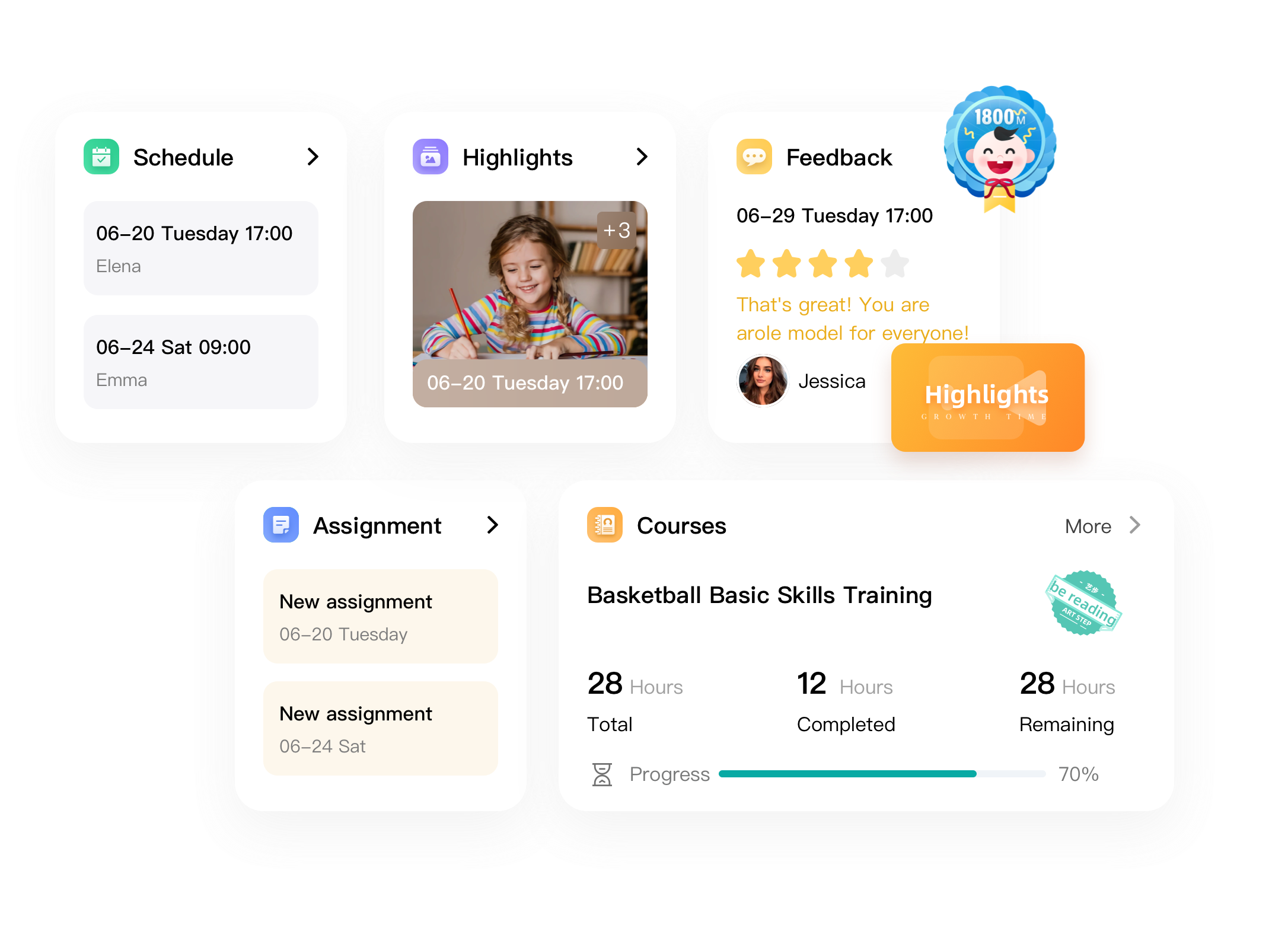
3.1 Clear learning data: clear course records, clear post class evaluations, and clear records of homework and exercise completion;
3.2 Clear service data: Clear records of service and communication processes, clear classification of services, and efficient integration;
3.3 Comprehensive service forms: parent teacher conferences, open classes, assessments, competitions, providing sufficient opportunities for use and display;
3.4 Clear feedback channels: The feedback mechanism for complaints and suggestions is rapid and effective, continuously enriching and improving the content of satisfaction surveys;
4. Institutional environment and learning atmosphere
4.1 Complete hardware facilities: meet the needs of teaching and practice, quality control monitoring, and emergency support;
4.2 Creating a learning environment: Personal real-time updated learning reports and phased learning competitions will inevitably give rise to more activities, competitions, cooperation methods, and opportunities, cultivating a positive and proactive learning attitude;
4.3 Learning Assistance: Provide students with sufficient learning support channels and conditions, rather than just using tools;
5. Value added services and long-term value
5.1 Surrounding courses and products: Provide sufficient extended courses and services to meet learning needs and support campus operations;
5.2 Student interaction design: Enhance activity participation, training excellence, and class consumption through student planning guidance, parent counseling, and other forms; 5.3 Student Development Design: Use rewards and additional experiential activities to promote student introductions and expand the private domain of parent leaders; 5.4 Iteration of Teaching Service Technology Development: Improve teaching and service efficiency, meet the integration of online and offline teaching and services, and enhance more comprehensive and efficient digital learning analysis reports;
In conclusion
Every institution claims to have good courses, teaching, research and teaching, and teachers. In summary, good educational and training institutions have the following characteristics of service:
1. Services should be able to objectively, linearly present, and compute data;
2. The learning speed should vary according to the learning performance and needs of students in different processes and campuses;
3. The core is centered around individual students rather than the class;
4. The ultimate goal is not to stay at the low dimensional cognition of "satisfying students", but to drive students and parents to cultivate correct learning attitudes through service, fully recognize the continuous help of indirect interests in learning, and establish long-term trust;
Good service is externalization, not simply institutions going to externalize themselves. If the services provided by educational and training institutions possess the above four characteristics, they will form a truly leading and sustainable competitiveness and vitality in the industry. As a result, costs will increase. Within the allowed adjustment space and without blindly reducing prices through internal competition, it will be a benign development direction facing industry competition in the new era.