






















Scientific scheduling is a skill that every training institution must possess
Time:2025-11-20
Source:Artstep
Don't just schedule classes randomly! Wasting time, energy, and money!
On the surface, academic management focuses on four aspects: scheduling, attendance, taking leave, and making up for missed classes.
But in essence, true academic management is based on three foundations: human efficiency, timeliness, and efficiency.
By managing the efficiency of these three aspects, we can improve the efficiency of the organization, enable it to operate quickly, and enhance its ability to make money.
The improvement of human efficiency, timeliness, and floor area efficiency lies in the reasonable planning of teacher arrangements, class schedules, and venue usage arrangements. At first glance, it may seem like an intelligent scheduling system, but in essence, the ArtStep scheduling system is based on these three designs. Proper use of the system can increase organizational efficiency by at least 20%, while reducing scheduling time and energy by at least 80%.
But from the perspective of the institution itself, improving these three aspects is only a process, and the more important thing is to enhance the institution's ability to consume courses. Only when the courses are consumed can the institution's income truly increase.
1. Course consumption is very important
Speaking of course consumption, I know many principals and teachers do not attach great importance to this matter, and even many campuses around them calculate profits based on enrollment instead of course consumption when distributing year-end dividends. I have talked about it before, and they also know that income should be calculated from course expenses.
However, the number of class hours per student is different, and the discounts for course enrollment are also different, resulting in different unit prices for class hours. This makes the calculation of income very complex and difficult to accurately calculate and analyze for implementation.
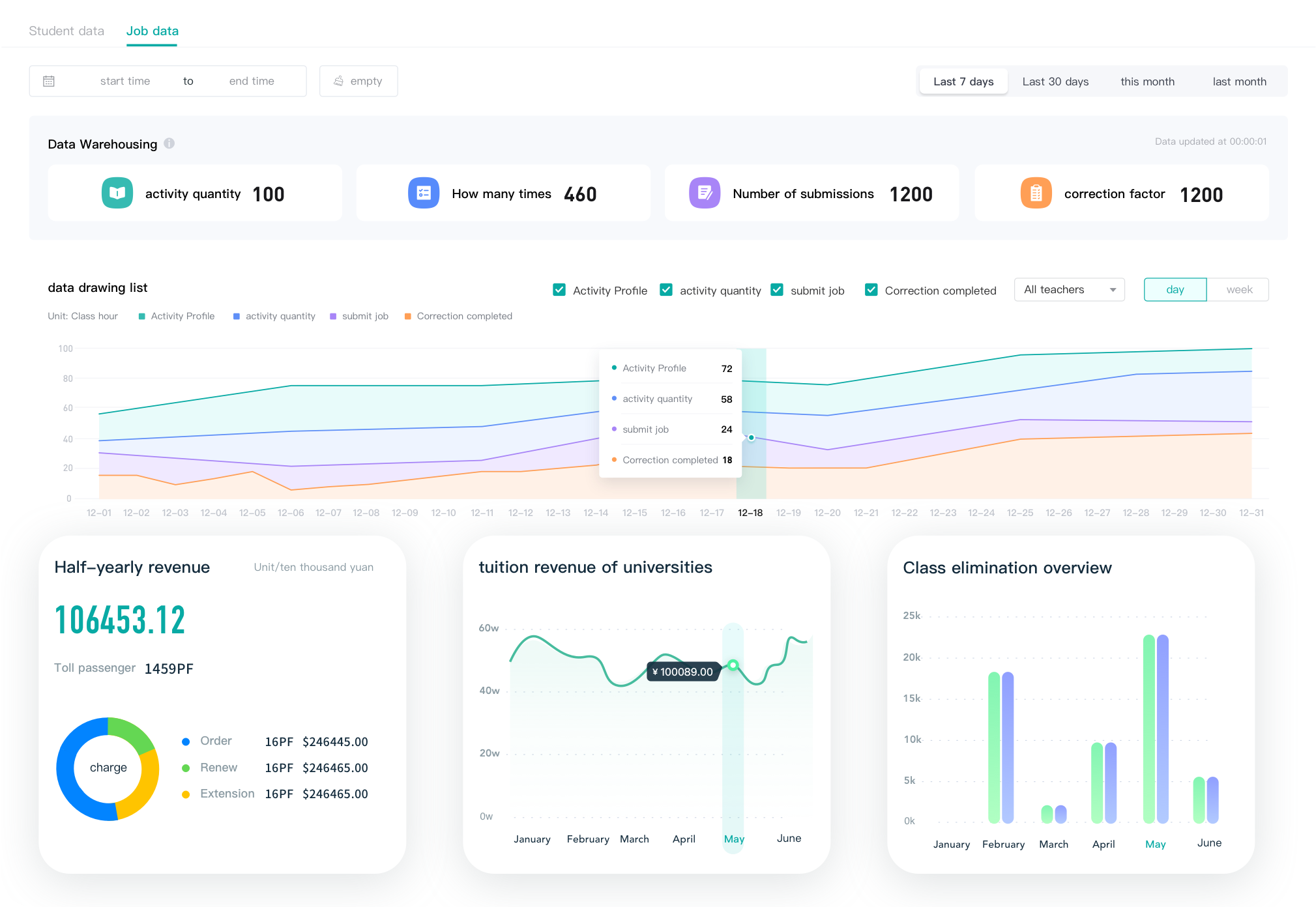
From the perspective of course consumption statistics, it is very necessary to use the system. This is the gap between human computing power and computer computing power. Today, there are 120 children attending classes in 15 classes. What is the course consumption cost for each child, what is the total course consumption income for the campus today, and what is the course consumption income generated by each teacher for today's class? After the roll call is completed, it can be effectively counted.
It is almost impossible for human resources to achieve this, and to do so, a full-time finance teacher must be present to track the entire process in order to achieve the same effect.
And more class management, student management, teacher management, data analysis, teacher performance, and everything else is built on course consumption data.
So as mentioned earlier, course consumption is the top priority of campus operation and management, an indisputable truth.
2. Scheduling courses should be efficient
So, in terms of course scheduling function, Artstep intelligently schedules courses from three dimensions: evaluation effectiveness, human effectiveness, and timeliness.
At the same time, the Artstep system puts weekend courses at the forefront, meeting the requirements of institutions based on the most intensive weekend courses. The colors of different teachers' schedules are also different, which makes it convenient for teachers to view the schedules.
3. The appointment function should be flexible
At the same time, "appointment course management" is almost a standard feature in the industry now. Taking dance training institutions as an example, the most suitable candidates for booking classes are not children, but adults. The initial development of the appointment course system was based on the demand of collaborative dance institutions.
After research, it was gradually found that there is a potential demand in the quality education industry. Taking dance institutions as an example, currently in Artstep's cooperative dance campuses, adult reservation classes account for more than 30% of the revenue, at least 10-20%.
And most of them have almost negligible income from this area without using our appointment management system. This is the help that choosing the right management system can bring to an organization.
4. Home school management:
Artstep Home School Management System creates an institution exclusive app that overcomes the barriers of time and space, allowing parents to communicate with schools at zero distance. By showcasing the school's high-quality service and professional attitude through channels such as WeChat official website, one-on-one information transmission, bidding farewell to the bombardment of WeChat group messages, parents are fully aware of the learning situation, online two-way mutual evaluation, efficient communication, and enabling teachers and students to make progress together.
The training institution chooses a management system that is a set of tools. The value it can bring is twofold: firstly, to control areas that were previously difficult to manage; secondly, to gradually change the management and even the operational mode of the institution during the use of the tools. So, choosing a training institution management system is choosing a management approach for the institution, and the focus is not on the number of functions, whether the brand is strong, or whether the price is cheap.
What really matters is whether it is suitable for the current development needs of the institution, matches the application scenarios that are not suitable for the institution, and whether it can be reproduced in the future to help the institution improve.