






















My Training Institution Operations: From Chaos to Control
Time:2025-10-24
Source:Artstep
Last Wednesday at 10 PM, I was staring blankly at my computer screen. I had just emailed parents about their children's recent learning progress at the center, including my comments and class photos.
But a full day had passed, and only about ten parents had replied with their thoughts on the feedback. Many hadn't even opened the email, making me wonder if it had been flagged as spam for some reason.
To make matters worse, a text message popped up from a parent: "Lily, I'd like to know how my child has been progressing lately. Please send me an update." I slapped my forehead, realizing that amidst the busy week, I had forgotten to write the after-class reviews for five students.
This wasn't the first time. Sometimes, when manually recording class hours, I'd miscalculate the remaining sessions for a student. Class reminders occasionally went out late, prompting parents to complain privately, "It feels like you don't really care about our kids." These fragmented problems piled up, leaving me overwhelmed every day.
Parents often said that as we enrolled more students, our service seemed less detailed and attentive.
Trying Everything to Improve Service
Trying Everything to Improve Service
To improve our service, I tried almost every method I could think of.
For instance, to increase parent response rates, I tried messaging them individually. But with so many students, I was often stuck typing until 8 PM, and sometimes I'd mix up details, sending Student A's information to Student B's parent. I also tried chatting with parents briefly after each class, but parents always had their own things to do, and it wasn't easy; not all parents had time for a chat.
Looking back, those failed attempts all revolved around "service design":
- wrote after-class reviews manually but was overwhelmed by the number of students.
- was eager to demonstrate professionalism but didn't consider the stage of trust with parents.
- had teachers wearing multiple hats, leading to divided attention and missed details.
- used Excel to track after-class feedback but often forgot to send it due to busyness.
- manually recorded class schedules but frequently miscalculated.
Once, a parent confronted me with a miscalculated class hour record, questioning our professionalism. I could only apologize, my face red, feeling utterly defeated. I knew good service could boost parent satisfaction, but I just couldn't find an efficient way.
Finding a "Lifeline": The Educational Management System
Finding a "Lifeline": The Educational Management System
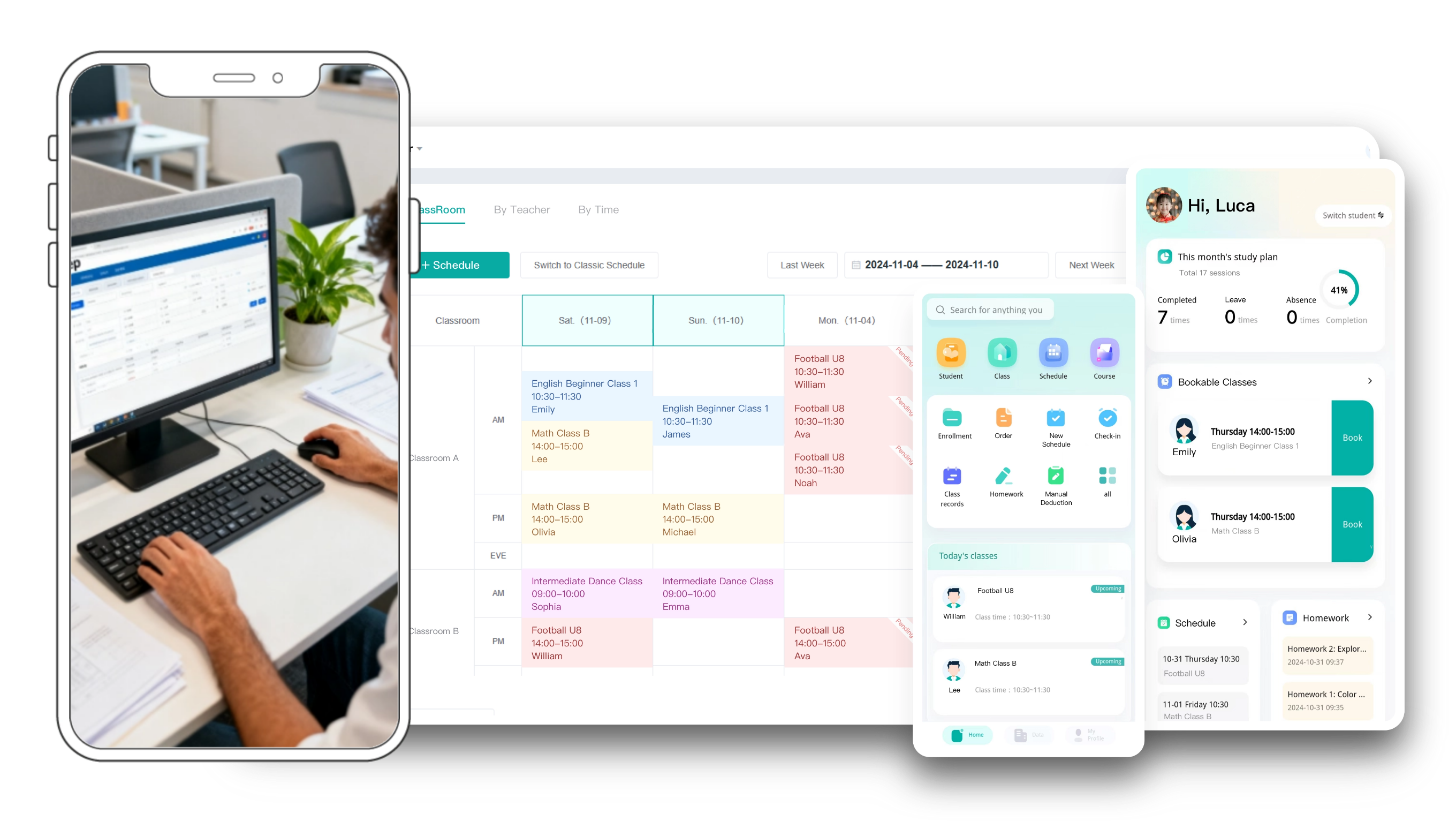
It wasn't until last month, when I discovered educational management systems online, that things changed. I signed up for one skeptically, only to find it was a veritable "lifesaver."
Most tasks I previously did manually, often working late, could now be automated. For example, homework check-ins: the system groups students and automatically pushes personalized comments to the corresponding parents. After-class feedback is also sent directly to parents' phones.
After we started using this system, parents received more information. They could see changes in their child's class hours and progress. Parents loved seeing this data; they found it transparent and reassuring.
With this system, parents were satisfied, and our workload became manageable.
Targeted Service: Establishing Exclusive Student Profiles and Personalized Push Notifications
1. Targeted Service: Establishing Exclusive Student Profiles and Personalized Push Notifications
We create exclusive electronic profiles for each student. The system contains each child's class performance, homework status, and learning progress. Highly personalized after-class reviews and learning analysis make parents feel the "one-on-one" dedicated attention.
It's crucial to understand that if our after-class feedback push notifications are generic and disconnected from the child's actual situation, parents will inevitably perceive the service as merely a formality and feel neglected.
This leads to parents becoming indifferent to the feedback, unwilling to communicate with teachers, hesitant to purchase more courses, questioning the institution's professionalism and dedication, and ultimately damaging the foundation of trust. An institution without parental trust will undoubtedly struggle to operate smoothly.
This approach significantly enhances parents' sense of involvement, trust, and satisfaction. When parents feel the institution is "truly keeping an eye on my child," they are more willing to cooperate with the teaching and develop strong brand loyalty.
The highlight of this aspect is using technology to transform traditional, time-consuming, manual personalized care into a scalable, standardized system function, achieving both efficiency and depth, making every parent feel uniquely served.
Balancing Service Intensity: Designing a Phased Service Rhythm
2. Balancing Service Intensity: Designing a Phased Service Rhythm
We set different service push rhythms for new and existing students based on the child's learning progress. New students initially receive lighter, positive basic feedback (e.g., "Your child was very enthusiastic today") to build rapport.
Once the relationship is stable, we gradually introduce deeper learning analysis and improvement suggestions. Based on our chats with parents, bombarding new parents immediately with extensive learning pressure and complex analysis reports can create anxiety and pressure, potentially scaring off clients where trust isn't yet established, leading to early attrition.
This radual communication strategy smoothly guides parents into a state of deeper interaction, avoiding resistance caused by information overload or inappropriate pressure.
This isn't just service; it's "customer relationship management." It's like an experienced friend who knows what to say at what stage. This sense of proportion is the core of high-end service, effectively lowering parents' psychological defenses and improving communication efficiency.
Clear Division of Labor: Implementing Modular, Specialized Operational Processes
3. Clear Division of Labor: Implementing Modular, Specialized Operational Processes
After implementing the educational management system, we established clear divisions of labor for our teachers. Customer service focuses on communication and answering questions, course consultants are responsible for driving sales and renewals, and teachers devote themselves entirely to instruction. The system ensures information synchronization across modules while maintaining clear responsibilities and authority.
Based on our previous daily operations, we knew all too well that blurred role definitions force teachers to shoulder significant sales and communication pressures, diverting their energy and lowering teaching quality. Simultaneously, sales and customer service, with unclear duties, might pass responsibilities back and forth, causing internal friction and inefficiency, ultimately affecting overall operational effectiveness.
Letting professionals focus on their areas of expertise not only improves the quality of each task (more focused teaching, more precise sales, more timely service) but also creates an efficient team collaboration mechanism.
Once the relationship is stable, we gradually introduce deeper learning analysis and improvement suggestions. Based on our chats with parents, bombarding new parents immediately with extensive learning pressure and complex analysis reports can create anxiety and pressure, potentially scaring off clients where trust ib(89, 89, 89); background-color: rgb(249, 242, 244);">Service Continuity: Building a Visual Growth Tracking System
4. Service Continuity: Building a Visual Growth Tracking System
The system automatically archives growth data from each class – comments, work, grades, etc. – forming a continuously updated, visual "growth diary." Parents can log in via their phones anytime to view their child's progress and changes throughout the entire learning cycle.
If service appears "fragmented," lacking coherent records after classes, parents cannot intuitively perceive the long-term learning value, easily leading to the misconception that "here's been no noticeable change after studying for so long." This is a key reason for renewal failures.
This approach strengthens the visualization of teaching outcomes and the perception of value. It transforms intangible "progress" into tangible "records," continuously demonstrating the value of the investment to parents. It is a powerful tool for maintaining parent confidence and building the institution's reputation.
Parents can trace and witness every step of their child's growth. If they want to see their child's progress, they just need to open their phones. This continuous emotional connection and value reminder is far more effective at stimulating renewal willingness than one-off promotions, significantly enhancing user loyalty.
Attention to Detail: Achieving Automated and Data-Driven Care
5. Attention to Detail: Achieving Automated and Data-Driven Care
We automated routine tasks like tracking class hour consumption and changes. Parents can see these updates on their phones without having to ask the teacher separately, which also reduces the teachers' workload.
I knew that errors in calculating class hours would directly give parents a negative impression of "chaotic management" and "unprofessionalism." Even if the courses themselves were good, it would make parents doubt the institution's reliability.
This way, parents trust us more.